
OSOU Syllabus 2026: Subject-Wise Course Structure
Odisha State Open University (OSOU) structures its undergraduate, postgraduate, and diploma syllabi across semester and annual frameworks. Degree programmes follow NEP-2020 guidelines with modular credit systems, while diploma programmes combine core theory units, practical lab sessions, assignments, and term-end evaluations.
Key facts
| UG Credit Structure (NEP-2020) | 160 Credits over 4 Years (Honours) |
|---|---|
| Master’s Programme Syllabi | NEP-2020 updated from 2024–25 session |
| Bachelor’s Programme Syllabi | NEP-2020 updated from 2025–26 session |
| DCA / DCS Programme Duration | Minimum 1 Year, Maximum 2 Years |
| PGDCA Programme Duration | 18 Months (3 Semesters) |
| Counselling Class Duration | 2 Hours (Theory), 3 Hours (Practical) |
NEP-2020 Undergraduate Degree Structure and Exit Options
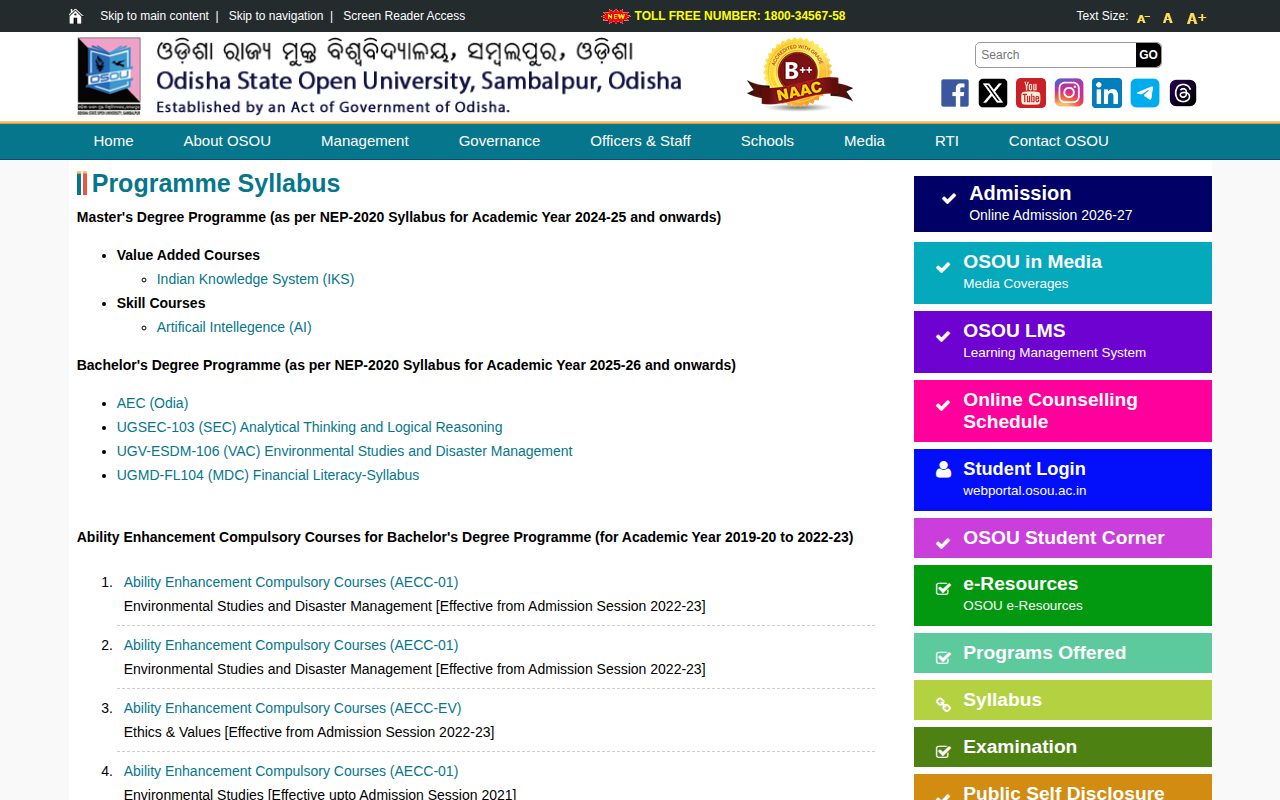
OSOU has updated its Bachelor’s degree syllabus structure to align with NEP-2020 starting from the 2025–26 academic year. Honours programmes such as BA in Economics (BAEC), English (BAEG), Hindi (BAHD), History (BAHI), Odia (BAOD), and Political Science (BAPS) offer flexible entry and exit points based on earned credits.
Undergraduate NEP-2020 Credit and Exit Framework
| Exit Level | Credit Requirement | Additional Criteria | Re-entry Allowance |
|---|---|---|---|
| UG Certificate | 40 Credits | 1 four-credit vocational course in summer vacation | Within 3 years (max 7 years duration) |
| UG Diploma | 80 Credits | 1 four-credit vocational course in summer vacation | Within 3 years (max 7 years duration) |
| 3-Year UG Degree | 120 Credits (3 Years) | Completion of major discipline requirements | Not applicable |
| 4-Year UG Degree (Honours) | 160 Credits (4 Years) | Completion of full 4-year curriculum | Not applicable |
Diploma in Computer Application (DCA) Syllabus Structure
The Diploma in Computer Application (DCA) is a 1-year course designed to provide fundamental IT skills. Weekend classes consist of 2 hours of theory and 3 hours of practical training. Evaluation is based on assignments, term-end examinations, and a final project report with a viva voce.
- Block 1: Computer Basics (characteristics, memory, input/output, SMPS, motherboard) and Number Systems (Binary, Octal, Hexadecimal conversions).
- Block 2: Windows OS (Windows 7 navigation, control panel, file/folder operations) and Linux OS (installation, directory structure, GUI, command line, terminal mode).
- MS Office Suite: MS Word (formatting, tables, shortcuts), MS Excel (formulas, conditional formatting, VLOOKUP, HLOOKUP, Pivot tables), and MS PowerPoint (slide notes, transitions, exporting to PDF/video).
Diploma in Cyber Security (DCS) Course Syllabus
The Diploma in Cyber Security (DCS) spans 1 year (maximum 2 years) and combines theoretical modules with practical lab sessions to prepare students for technical roles in system security and network defense.
- CSPC-01 (Data Communication & Networking): OSI and TCP/IP models, switching techniques, CSMA/CD, transport layer (TCP/UDP), and application protocols (HTTP, HTTPS, DNS, FTP).
- Information Security & Cryptography: Private/public key systems, RSA algorithm, malware types (viruses, worms, trojans), ethical hacking, and IT Act 2000.
- CSPC-04 & CSPCL-04 (Application Cyber Security & Lab): Operating system security, web security vulnerabilities (SQL injection, injection flaws), and document/user account protection.
- CSPC-05 & CSPCL-05 (Network Cyber Security & Lab): Firewall security configuration in Windows, wireless network components, and e-commerce/e-mail security analysis.
Post Graduate Diploma in Computer Application (PGDCA) Structure
The PGDCA programme covers 18 months split into 3 semesters. Counselling sessions follow a format of 2 hours for theory and 3 hours for practical coursework.
- 1st Semester: Theory Course CSP-40 (Computer Fundamentals, Windows, Linux, MS Office) and CSP-11 (Data Communication & Networking, 6 credits).
- 2nd Semester: Theory Course CSP-42 covering intermediate software application and systems skills.
- 3rd Semester: Theory Course CSP-45, focus on project work and advanced IT application handling.
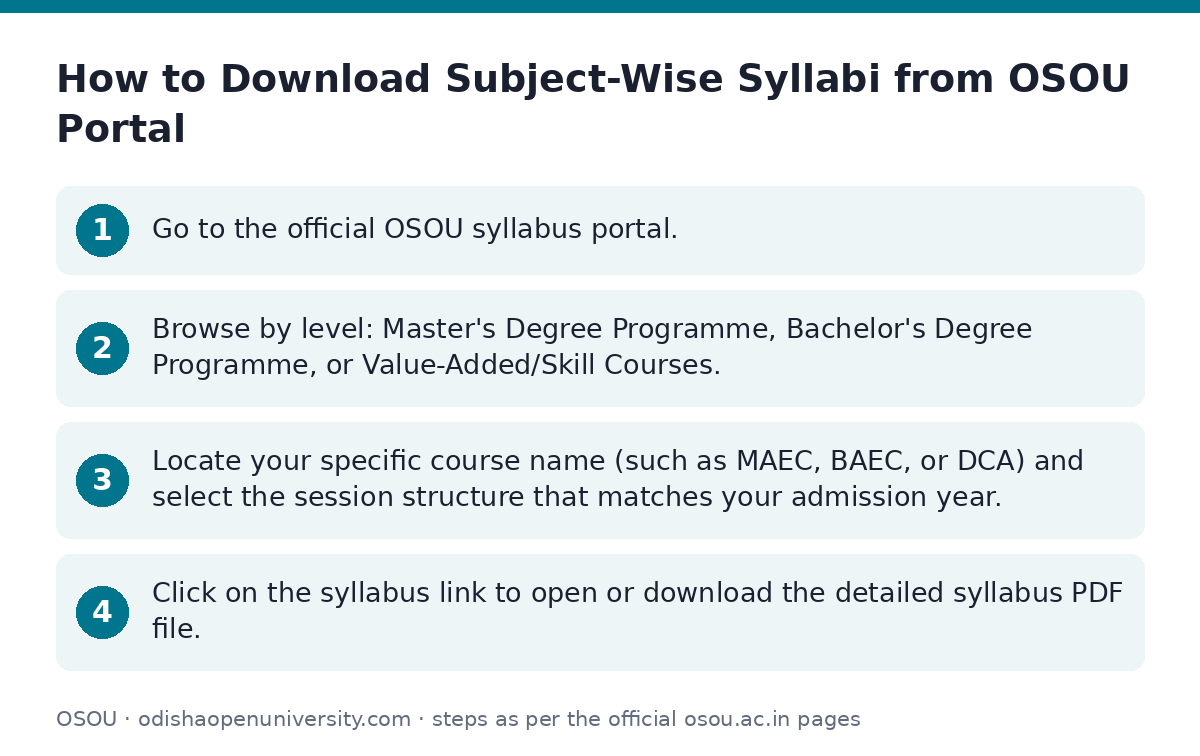
How to Download Subject-Wise Syllabi from OSOU Portal
Students can view and download syllabus documents directly from the university portal for all active academic sessions.
- Go to the official OSOU syllabus portal.
- Browse by level: Master’s Degree Programme, Bachelor’s Degree Programme, or Value-Added/Skill Courses.
- Locate your specific course name (such as MAEC, BAEC, or DCA) and select the session structure that matches your admission year.
- Click on the syllabus link to open or download the detailed syllabus PDF file.
Important OSOU links
| What you can do | Official page |
|---|---|
| Download official course syllabus PDFs | osou.ac.in/programmesyllabus.php |
| Explore all academic programmes offered | osou.ac.in/programmes.php |
| Check list of available admission programmes | onlineadmission.osou.ac.in/programmes.php |
| View BAEC programme structure and fees | onlineadmission.osou.ac.in/programmes.php?prog=BAEC |
Official documents (PDF)
- Entrance Test (2nd phase) for MBA in Disaster Management – Academic Year 2026-27, Academic… PDF — MBA in Disaster Management Entrance Test details
- UGC Approval to offer 4 PG programme from Academic Year 2024-25, Academic Session beginning… PDF — UGC Approval for 4 PG programmes
Frequently asked questions
Does OSOU offer a Diploma in Odia and Communication?
No. The university syllabus directory lists Master of Arts in Odia (MAOD), Bachelor of Arts (Honours) in Odia (BAOD), and AEC Odia courses, but does not list a standalone Diploma in Odia and Communication.
How good are OSOU’s study materials?
OSOU provides interactive Self-guided Learning Materials (SLM) alongside Open Educational Resources (OERs), weekend counselling sessions, video lectures, and practical project guidance to facilitate distance learning.
Is OSOU’s curriculum up-to-date?
Yes. OSOU updated its Master’s degree course structures to follow NEP-2020 starting in the 2024–25 session, and implemented the NEP-2020 syllabus framework for Bachelor’s degree programmes for the 2025–26 session.
Does OSOU offer a B.Ed program?
No. While OSOU lists a School of Teacher Education under its institutional setup, B.Ed is not included in the active programmes offered on the university’s admission portal.
What is the class schedule for diploma programmes like DCA and DCS?
Classes for diploma programmes are held on weekends (preferably Sundays). They include 2 hours of theory counselling and 3 hours of practical laboratory work per session.
What is the duration of the PGDCA programme at OSOU?
The Post Graduate Diploma in Computer Application (PGDCA) has a total duration of 18 months (1.5 years) spread across 3 semesters.
Sources
Written from the official OSOU pages and documents below, as read on 2 October 2026.
- DCA-Syllabus.pdf osou.ac.in/…/DCA-Syllabus.pdf
- OSOU-PGDCA-SYLLABUS-18.pdf osou.ac.in/…/OSOU-PGDCA-SYLLABUS-18.pdf
- DCS-Syllabus-2022-23.pdf osou.ac.in/…/DCS-Syllabus-2022-23.pdf
- Syllabus osou.ac.in/…/programmesyllabus.php
- Available Programs onlineadmission.osou.ac.in/…/programmes.php
- Bachelor of Arts (Honours) in Economics (BAEC) | Online Admission | Odisha State Open Univ onlineadmission.osou.ac.in/…/programmes.php